It's a close game and your team falls behind late. You glance at the scoreboard and start thinking, "We're going to lose." A few moments later, the referee makes a decision you strongly disagree with. Frustrated, you can't stop replaying the call in your head. Instead of focusing on the next play, your attention is on the score, the referee, and how unfair it all feels. Before you know it, you're a step behind the play, your confidence has dropped, and the game has moved on without you.
Every athlete wants to perform at their best, but one of the biggest mistakes we see is spending too much mental energy on things they can't actually control.
It's completely normal to worry about the result, what your opponent is doing, or whether the referee is making the right calls. The problem is that these thoughts don't improve your performance. In fact, they often distract you from the very things that do.
One of the most valuable mental skills in sport is learning to separate what you can control from what you can't.
Our brains naturally want certainty. Before and during competition, they constantly scan for things that might affect the outcome. Unfortunately, this often leads us to focus on factors outside our control, like the weather, the opposition, or the scoreboard.
The irony is that the more attention we give these uncontrollable factors, the less attention we have available for the things that actually influence our performance.
This is why sport psychologists often encourage athletes to focus on the process rather than the outcome.
Obviously winning is something we strive for, but it isn't something we can completely control. Think about what it actually means to control something. If you truly controlled the result, then doing all the right things would guarantee a win every time. But sport doesn't work like that.
Even if you prepare perfectly, execute your game plan, and perform near your best, your opponent also has a say in the outcome. They're trying just as hard to beat you. In reality, you only ever control part of the equation.
Even the greatest athletes in history lose. If results were completely controllable, they never would.
When athletes become overly focused on uncontrollables, they can often experience more frustration, anxiety and emotional ups and downs. Common examples include worrying about:
The problem isn't that these things don't matter, they clearly do. The problem is that worrying about them can’t change them.
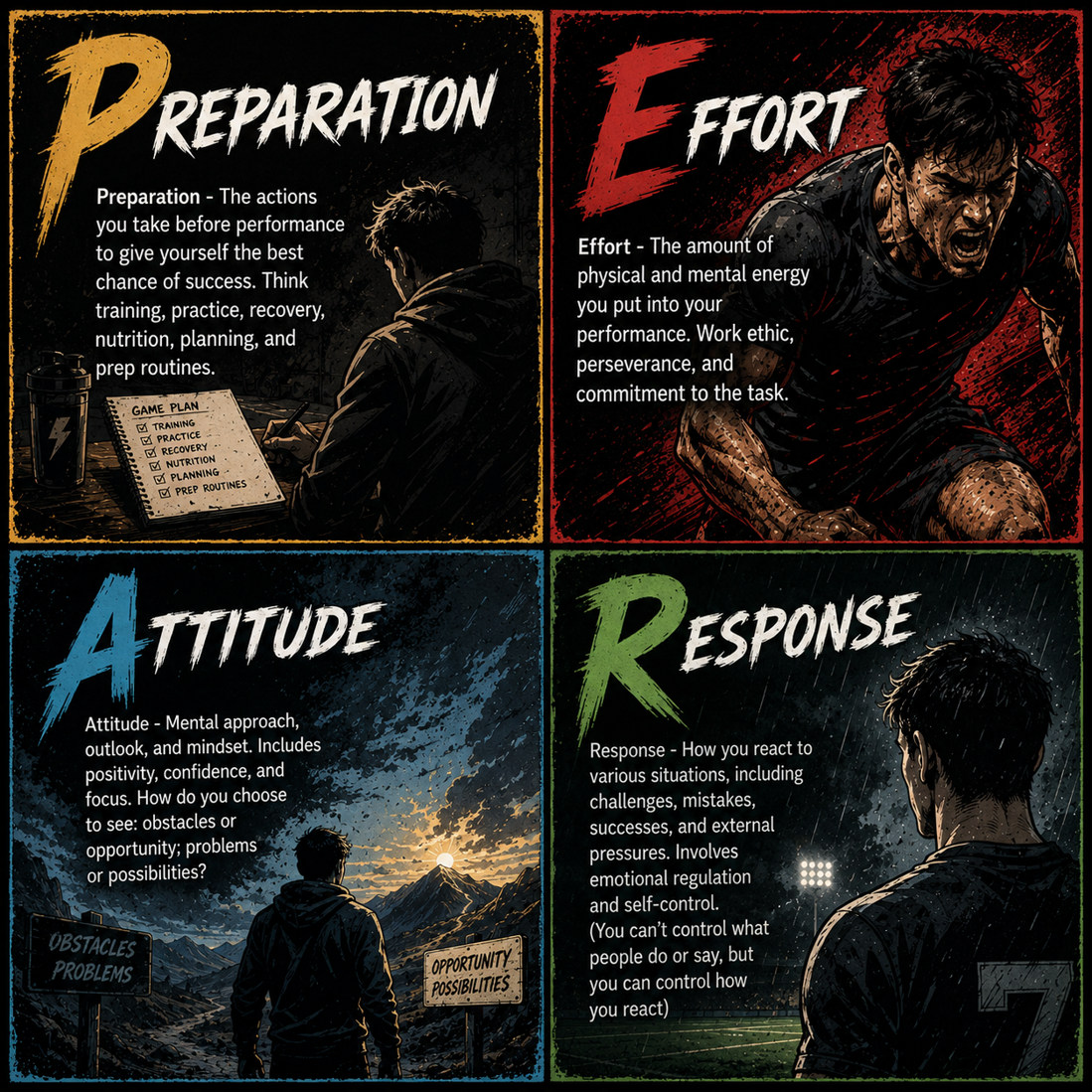
One framework we often use with athletes is P.E.A.R., the four things you have 100% control over, 100% of the time.
The more consistently athletes bring their attention back to these four areas, the more resilient and consistent they become. Rather than being pulled around by circumstances, they stay focused on actions that genuinely improve performance.
Every athlete wants good results, but results are a by-product of consistently doing the controllable things well.
When you find yourself distracted during training or competition, ask yourself:
"Is this something I can control?"
If the answer is no, practise letting it go and redirect your attention to your Preparation, Effort, Attitude or Response.
You may not be able to control whether you win today, but you can always control how you compete. Ironically, that's often what gives you the best chance of winning in the long run.